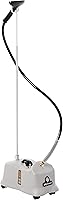
8 Best Steamers for Curtains and Drapes (October 2026)
The best steamers for curtains and drapes include the SALAV Heavy Duty Commercial Steamer for long curtain runs, the Rowenta Professional Full-Size Steamer for controlled passes, and the Jiffy J-2000 Garment Steamer for extended home sessions.
On this page (7 sections)
- Which steamer works best for curtains and drapes?
- Best steamer for curtains: which model fits your room?
- How do you choose the best steamer for curtains?
- How do you set up a curtain steamer?
- How do you steam curtains without damaging them?
- What mistakes should you avoid when steaming curtains?
- Which curtain steamer should you choose?
The best steamer for curtains for most homes is the SALAV Heavy Duty Commercial Steamer, with a 3 L tank and foot pedal control for long panels. Rowenta offers adjustable steam levels, while the Jiffy J-2000 is suited to sessions that benefit from a long steam time per fill.
A full-size steamer can smooth hanging curtains without taking them down. Check the fabric care label first, then test a hidden area to see how the material responds.
For a step-by-step method, read our guide to steaming curtains without taking them down. If you’re choosing between a handheld and standing model, our roundup of garment steamers for home use covers other household jobs.
Our picks at a glance
-
1

-
2
-
3
- 4Check it
SALAV XL 3L Professional Steamer
Best for low-water alerts - 5
 Best for frequent heavy useCheck it
- 6
 Check it
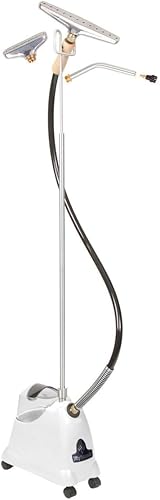
Jiffy J-2000I Multi-Purpose Steamer
Best for a smaller tank - 7
 Check it
True & Tidy Heavy-Duty Steamer
Best for three steam levels - 8
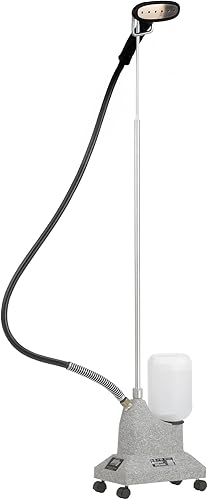 Best for a metal-faced headCheck it
Which steamer works best for curtains and drapes?
The SALAV Heavy Duty Commercial Steamer is the best overall fit for long curtain runs because its large tank, foot pedal and rolling base support extended sessions. Rowenta suits curtains that call for more control over steam output.
We compared capacity, heat-up time, steam settings and handling features against common curtain jobs. These details help you estimate refills, reach and storage needs before you choose.
| Product | Best for | Tank | Heat-up | Controls | Our score |
|---|---|---|---|---|---|
| SALAV Heavy Duty Commercial Steamer | long curtain runs | 3 L | 45 seconds | Foot pedal | 8.6 |
| Rowenta Professional Full-Size Steamer | controlled passes | 1.3 L | 45 seconds | 8.3 | |
| Jiffy J-2000 Garment Steamer | extended home sessions | 2.84 L | 2 minutes | 8.2 | |
| SALAV XL 3L Professional Steamer | low-water alerts | 3 L | 45 seconds | 7.8 | |
| Jiffy J-4000 Garment Steamer | frequent heavy use | 1 gallon | 15 minutes to standby temperature | 7.7 | |
| Jiffy J-2000I Multi-Purpose Steamer | a smaller tank | 0.75 L | 1 minute | 7.5 | |
| True & Tidy Heavy-Duty Steamer | three steam levels | 3 L | 90 seconds | 7.4 | |
| Jiffy J-2S Garment Steamer | a metal-faced head | 2 minutes | 7.0 |
Best steamer for curtains: which model fits your room?
Match the steamer to the number, length and fabric of your curtains. A large tank helps with several long panels, while a smaller reservoir can be easier to manage for one window or occasional touch-ups.
SALAV Heavy Duty Commercial Steamer: best steamer for curtains with long panels
SALAV Heavy Duty Commercial Steamer: Best for long curtain runs
- 3 L removable tank
- 90+ minutes of continuous steam
- 45-second heat-up
- Foot pedal control
The 3 L tank and foot pedal suit long curtain panels and repeated room-to-room steaming. Wheels and a telescopic pole help with movement and storage.
Pros
- Large tank for long sessions
- Foot pedal control
- Rolling wheels and telescopic pole
Cons
- Tall standing unit needs storage space
- Requires an outlet that supports 1800 watts
The SALAV Heavy Duty Commercial Steamer is the strongest match for long curtain runs. Its 3 L removable tank provides 90+ minutes of continuous steam, and the foot pedal activates steam without requiring you to reach for a switch on the unit.
The telescopic aluminum pole and 360-degree rolling wheels help you move it from one window to another. Its built-in hanger is designed for garments, so keep the curtain supported on its rod as you work.
SALAV describes this model for curtains and upholstery as well as clothing. It heats in 45 seconds and draws 1800 W, so plan to use an outlet that can support that load.
Choose it for several long or wide panels in one session. Skip it if you only touch up one short curtain now and then, or if you have no practical place to store a tall standing unit.
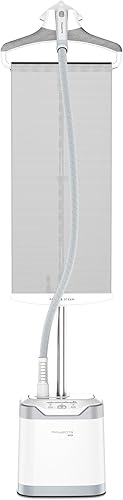
Rowenta Professional Full-Size Steamer: best steamer for curtains with varied fabrics
Rowenta Professional Full-Size Steamer: Best for controlled passes
- 1.3 L removable tank
- Four steam settings
- Steam & Press vertical support
- 45-second heat-up
Four settings and a vertical support give you more control as you work across different curtain fabrics. Its tank is smaller than the 3 L options.
Pros
- Four adjustable steam settings
- Vertical support system
- Auto-off and anti-calc function
Cons
- Smaller tank than other picks
- Curtain-specific attachment is not specified
The Rowenta Professional Full-Size Steamer suits curtains that need a more controlled pass. Four steam settings let you adjust output, and the Steam & Press vertical support provides resistance while you work.
Its 1.3 L removable tank is smaller than the 3 L tanks on several other picks. That tradeoff matters if you’re steaming multiple floor-length panels, though its 45-second heat-up suits a quick single-room job.
Rowenta includes a fabric brush, steam bonnet and crease attachment. The XL Delta Steam Head is designed for precise steam diffusion, and the unit includes auto-off and an anti-calc function.
Choose Rowenta if you value adjustable output and vertical support more than the longest run between refills. Skip it for a large set of heavy drapes if frequent stops to refill would disrupt the job.
Jiffy J-2000: best steamer for curtains across several rooms
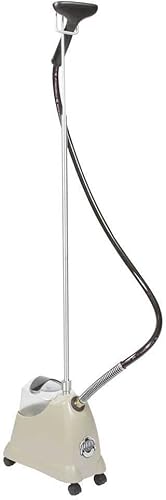
Jiffy J-2000 Garment Steamer: Best for extended home sessions
- 2.84 L water capacity
- 1.5 hours of steam per filling
- Two-minute heat-up
- Wheels for mobility
A 2.84 L capacity and long steam time make this a practical choice for several rooms or large drapes. Its plastic steam head and wheeled base suit home use.
Pros
- Long stated steam time per filling
- Five-foot flexible hose
- No-drip valve system
Cons
- Two-minute heat-up
- No adjustable steam settings specified
The Jiffy J-2000 is a practical fit for larger home steaming sessions, with a 2.84 L tank and a stated 1.5 hours of steam per filling. Its wheels help you move it between rooms, while the five-foot flexible hose gives you working reach from the base.
The plastic steam head and no-drip valve system are core features. It takes two minutes to heat, a little longer than the quick-start SALAV and Rowenta models, but its stated steam time can reduce interruptions once you begin.
Jiffy describes the J-2000 for home or commercial use. Its assembled height is 64 in, so check the space where you plan to store it.
Choose this model if you expect to steam curtains along with several garments in one session. For occasional use, its larger frame and reservoir may be more than you need; see our Jiffy steamer models guide for a closer comparison.
SALAV XL 3L Professional Steamer: best steamer for curtains with water alerts
SALAV XL 3L Professional Steamer: Best for low-water alerts
- 3 L tank
- 45-second heat-up
- Low-water light and audible alert
- Auto shut-off
The 3 L tank fits extended curtain work, while the alert and auto shut-off help you track water during a session. It has wheels and an adjustable pole.
Pros
- Large tank
- Low-water alert
- Auto shut-off after alert cycle
Cons
- No steam settings specified
- Tall standing unit needs storage space
The SALAV XL 3L Professional Steamer pairs a large tank with a low-water alert and automatic shut-off. A light and audible alert signal low water, then the unit powers down after the alert cycle.
Its 3 L tank and 45-second heat-up suit long curtain sessions. Wheels and an adjustable telescopic pole support room-to-room movement and compact storage, and it comes with a fabric brush and pants press attachment.
SALAV describes the model for home and commercial garment care, including curtains. Adjustable steam levels aren’t specified, so choose it for tank size and water alerts rather than output control.
Choose it when you want a large reservoir and a clear signal as water runs low. Skip it if you need specific steam settings for multiple delicate fabrics; compare it with the SALAV and Jiffy steamer guide.
Jiffy J-4000: best steamer for curtains used in frequent sessions
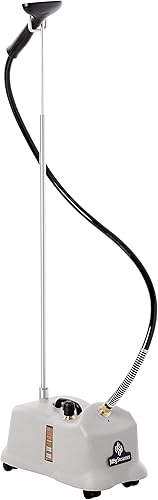
Jiffy J-4000 Garment Steamer: Best for frequent heavy use
- 1 gallon water tank
- 1500 W heating element
- Standby and steam settings
- 360-degree swivel casters
The 1 gallon tank and commercial-use design suit frequent, longer sessions. Allow for its stated 15-minute wait to reach standby temperature.
Pros
- Large water tank
- Standby and steam settings
- Swivel casters
Cons
- Longer stated heat-up time
- Commercial design may be more than occasional curtain care needs
The Jiffy J-4000 is designed for frequent use, with a 1 gallon self-contained water tank and a 1500 W heating element. Its standby and steam settings provide a simple two-mode control.
It has 360-degree swivel casters and a five-and-a-half-foot flexible hose. The plastic steam head is six inches wide, a detail to consider if your curtains have narrow pleats or tight spaces.
It takes 15 minutes to reach standby temperature, so plan ahead before a session. Jiffy describes it as a commercial-use model and notes that it can steam items such as tablecloths and bedspreads.
Choose it if you steam often and want a large tank. Skip it if you want a quick start for occasional curtain care.
Jiffy J-2000I: best steamer for curtains in short touch-ups
Jiffy J-2000I Multi-Purpose Steamer: Best for a smaller tank
- 0.75 L capacity
- One-minute heat-up
- 1300 W
- 120 V
The smaller capacity makes this a fit for shorter curtain jobs or occasional touch-ups. Its one-minute heat-up is quick, but a larger set of panels may need refills.
Pros
- Quick stated heat-up
- Smaller capacity than other picks
- 1300 W
Cons
- Smallest tank in this roundup
- No steam time or curtain-specific features specified
The Jiffy J-2000I is the smaller-tank choice in this roundup, with 0.75 L capacity and a one-minute heat-up. That can suit one short panel or an occasional refresh when you don’t need a large reservoir.
Its stated power is 1300 W, and the unit is 120 V. Details about its steam hose, head, settings and expected steam time aren’t specified, so consider whether its setup will work for your curtain height and session length.
The small tank means more attention to refills during a whole-room job. Choose it for a limited task where compact capacity matters; for a pair of long drapes, a 2.84 L or 3 L option is better suited.
True & Tidy Heavy-Duty Steamer: best steamer for curtains with three settings
True & Tidy Heavy-Duty Steamer: Best for three steam levels
- 3 L tank
- Three steam settings
- 1800 W
- Rolling wheels and retractable pole
Three steam settings let you adjust output for different fabric weights, while the 3 L tank supports longer sessions. The retractable pole helps with storage.
Pros
- Three adjustable steam settings
- Large removable tank
- Rolling wheels
Cons
- 90-second stated heat-up
- No automatic shut-off specified
The True & Tidy Heavy-Duty Steamer offers three steam settings and a 3 L tank, making it a flexible option for rooms with curtains of different fabric weights. Its stated 1800 W output and 90+ minutes of steam per fill suit larger jobs.
The removable tank, rolling wheels and retractable telescopic pole support moving and storing the unit. Its multifunctional hanger is designed for garments, so keep curtains supported on their rods as you work.
The stated heat-up time is 90 seconds. Automatic shut-off isn’t specified, so choose this model for adjustable output and tank size rather than a water-alert feature.
Choose it if you want to change steam levels between curtain fabrics. Skip it for a single lightweight panel if the larger tank and standing setup would go unused.
Jiffy J-2S Garment Steamer: best steamer for curtains with a metal-faced head
Jiffy J-2S Garment Steamer: Best for a metal-faced head
- Plastic head with stainless steel face
- Five-and-a-half-foot flexible hose
- Swivel casters
- Automatic shut-off fusible link
The metal-faced steam head and flexible hose give you a different handling setup for curtain work. Its specs give a two-minute heat-up time.
Pros
- Stainless steel face on steam head
- Flexible hose
- Swivel casters
Cons
- Two-minute heat-up
- Tank capacity is 1 gallon
The Jiffy J-2S stands out for its plastic steam head with a stainless steel face and a five-and-a-half-foot flexible hose. Swivel casters help you reposition the base while working along a curtain.
The specs give a two-minute heat-up and 1500 W of power. The product description calls it J-2M and gives 1300 W with steam in less than two minutes, so the model and power details are inconsistent.
The product information gives a one-gallon capacity, an automatic shut-off fusible link and a three-year warranty. Choose it if the head and hose setup suit your handling needs, but verify the exact model details before buying.
How do you choose the best steamer for curtains?
The best choice depends on how much fabric you need to cover, how high the rod sits and whether the curtains have different care needs. Think through the whole job, including moving the steamer and storing it afterward.
Tank size and session length: A larger tank can reduce refill breaks across multiple panels, but the steamer may be heavier to move when full. The 3 L models and Jiffy J-2000 suit longer sessions; the 0.75 L J-2000I better fits a short touch-up.
Reach and room layout: Check the hose length, pole height, cord reach and wheel access. A tall window or stairwell can make reach more important than heat-up time, and a nearby outlet helps you avoid stretching the cord across a walkway.
Fabric control: Steam settings are useful if one room has curtains in different materials. Rowenta has four and True & Tidy has three; with other models, follow the care label and start cautiously on a hidden section.
Storage and setup: Standing steamers take floor and vertical space. Measure the intended storage spot, check the assembled height and leave room to place the unit near the curtains without blocking a doorway.
Water handling and care: Some features address low water or mineral buildup. The SALAV XL alerts and shuts off after its alert cycle, while Rowenta includes an anti-calc function; follow the individual care instructions for filling and cleaning.
How do you set up a curtain steamer?
Set up the steamer on a stable, level floor near the curtains and an appropriate outlet. Assemble the pole, hose and head according to the unit’s instructions, then fill the tank as directed before turning it on.
Keep the base away from the curtain hem and any area where water could pool. Route the cord behind you or along a wall so it doesn’t cross your working path.
Wait for the model’s stated heat-up time before steaming. If the unit has steam settings, start low on an inconspicuous section and raise the setting only if the fabric care label allows it and the fabric responds well.
Let the steamer cool before draining or storing it. Empty remaining water if the care instructions recommend it, and store the hose without sharp bends.
How do you steam curtains without damaging them?
You can reduce the risk of marks or heat damage by checking the care label, testing a hidden area and keeping the steam head moving. Let each panel dry before closing it or tying it back.
Start near the top and work down in overlapping sections, keeping the head at a comfortable distance and your hands out of the steam path. Use smooth passes rather than holding steam on one spot.
Don’t steam blackout coatings, glued trims or delicate fabrics unless their care instructions allow it. If a panel has a lining, test the face fabric and lining separately because they may respond differently.
For the full process, follow our guide to steaming curtains while they hang. If you’re deciding between garment steaming and pressing, read steamer or iron for clothes.
What mistakes should you avoid when steaming curtains?
The most common mistakes are skipping the care label, using too much steam on a delicate area and rushing through a damp panel. A few simple checks can help protect the fabric and make each pass more useful.
Don’t assume every curtain fabric tolerates steam just because it hangs vertically. Test a hidden hem or back edge first, and stop if the fabric changes texture, color or shape.
Avoid leaving the steam head in one place. Keep it moving, don’t press it against coatings or trims, and follow the steamer’s distance and handling instructions.
Don’t close or tie back damp curtains. Give the fabric time to dry fully so moisture isn’t trapped in folds.
Don’t ignore the water tank or care directions. Mineral buildup can affect steam appliances over time, and water guidance differs by model; SALAV recommends distilled water to help reduce buildup from hard water.
Which curtain steamer should you choose?
Choose the SALAV Heavy Duty Commercial Steamer for long curtain runs and fewer refills, Rowenta for adjustable steam levels, and Jiffy J-2000 for a long stated steam time per fill. The J-2000I fits occasional short jobs, while the SALAV XL adds a low-water alert and automatic shut-off.
Before buying, match the tank and hose reach to your curtains, confirm that the fabric allows steaming, and plan a nearby outlet and storage spot. For a few tall panels, a wheeled full-size best steamer for curtains is a sensible fit; for one quick touch-up, choose a smaller setup.
Our top 3 picks at a glance
-
1
-
2
-
3
Frequently asked questions
Can you steam curtains while they are hanging?
Yes, if the fabric care label allows steaming and you can reach the full panel safely. Work from top to bottom in sections, keep the steam head moving, and follow the steamer instructions.
Test a hidden area first, especially on delicate or coated fabric.
What type of steamer is best for curtains?
A full-size standing steamer is usually practical for long or wide curtains because it has a larger water tank and can move around the room on wheels. A smaller tank can work for a short panel or an occasional touch-up.
Check the hose and pole reach against the height of your curtain rod.
How much water capacity do I need to steam curtains?
Choose tank capacity based on how many panels you plan to steam in one session. The SALAV and True & Tidy options here have 3 L tanks, while the Rowenta has a 1.3 L tank.
A larger tank can mean fewer refills, but it also adds water weight when full.
Should you use distilled water in a curtain steamer?
Follow the steamer's care instructions for water type. SALAV recommends distilled water to help reduce mineral buildup from hard water.
If you're also caring for clothes with a steam iron, see our guide on whether you need distilled water in a steam iron.
How do you avoid water marks when steaming curtains?
Check the fabric care label, test a hidden spot, and keep the steam head moving instead of holding it against one area. Let the panel dry before closing or tying it back.
Avoid steaming fabric that the care label says should not be exposed to steam.